
Have you ever walked into your living room, seen new scratch marks on your couch, and felt your heart sink?
If you are trying to learn how to stop cat scratching furniture naturally, you are not alone. This is one of the most common cat behavior problems, and it can make you feel frustrated, tired, and even a little helpless. You love your cat, but you also want your home to stay in one piece.
The good news is this: your cat is not being naughty on purpose. Scratching is normal cat behavior. Your cat is not trying to upset you or ruin your favorite chair. Your cat is doing something natural, necessary, and deeply wired into the body and brain. Once you understand why it happens, you can guide your cat toward better scratching habits without fear, pain, or punishment.
In this article, you will learn why cats scratch, what makes furniture so tempting, and how you can gently teach your cat to use better scratching spots. You will also get practical steps that actually help, even if you feel confused or stressed right now.
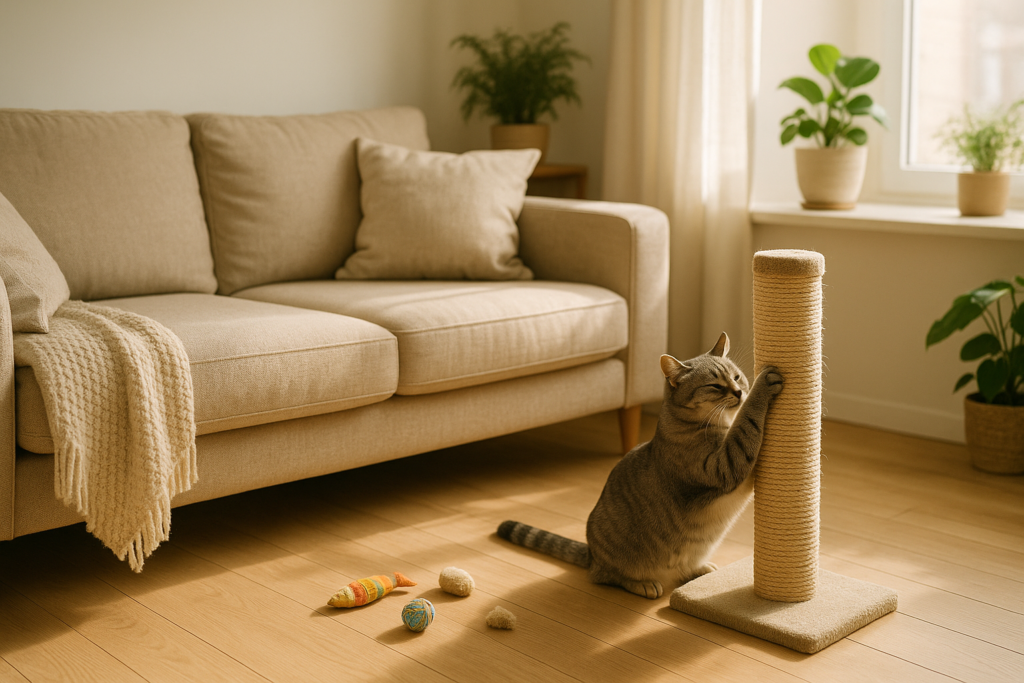
Why your cat scratches furniture in the first place
Before you can fix the problem, you need to know what is causing it. Scratching is not random. Your cat scratches for real reasons.
Scratching helps your cat care for the claws
When your cat scratches, the outer layer of the nails can shed off. This helps keep the claws healthy. It is a little like natural nail care.
That means scratching is not just a bad habit. It is part of your cat’s body care routine.
Scratching stretches the body
When your cat reaches up and scratches, the shoulders, legs, paws, and back get a good stretch. It feels good. It helps your cat release energy and tension.
This is why many cats scratch after a nap. They wake up, stretch, and scratch all in one little routine.
Scratching marks territory
Cats have scent glands in their paws. When your cat scratches, it leaves both a visible mark and a scent mark. That tells other animals, “This is my space.”
Even if you only have one cat, your cat may still feel the need to mark safe places in the home.
Scratching helps with emotions
Cats may scratch more when they feel excited, stressed, bored, playful, or overstimulated. If your cat scratches when guests come over, when another pet walks by the window, or right before dinner, emotions may be part of the reason.
Furniture often feels perfect
Your couch may be more attractive than any scratching post you bought. Why? Because furniture is often:
- Sturdy
- Tall enough for a full stretch
- Covered in satisfying fabric
- Placed in important family areas
- Already marked with your cat’s scent
So if your cat scratches the sofa, it does not mean your cat hates the scratching post. It may just mean the couch wins in comfort, position, or texture.
Why punishment usually makes things worse
When you feel frustrated, it is tempting to clap, yell, spray water, or scold. But punishment usually does not teach your cat what to do instead.
Your cat may only learn:
- You are scary sometimes
- Scratching is risky when you are nearby
- The scratching post has nothing to do with the problem
- Stress in the home is higher
A stressed cat may actually scratch more. Also, punishment can hurt trust between you and your cat.
If you want long term change, the best path is simple: make the right place easy and rewarding, and make the wrong place boring or hard to use.
How to stop cat scratching furniture naturally
Natural solutions work best when you use them together. Think of this like building a new routine for your cat.
Step 1: Give your cat a better scratching option
This is the most important step. If you only try to block the couch, your cat may just move to another chair. You need to offer a scratching spot that feels even better than the furniture.
Choose the right type of scratching post
Not all scratching posts are equal. Many are too short, too light, or too wobbly. Your cat wants something solid.
Look for a post or scratcher that is:
- Tall enough for a full body stretch
- Strong and stable
- Covered in sisal, cardboard, or another cat friendly material
- Easy to reach
- Placed in a useful location
Some cats like vertical posts. Some like horizontal scratchers. Some like angled scratchers. If you are not sure what your cat prefers, try more than one style.
Watch your cat’s scratching style
Your cat is already showing you clues.
Use this table to match your cat’s habit with the best scratching setup:
| What your cat does | What it may mean | What to provide |
|---|---|---|
| Scratches the side of the couch | Likes vertical scratching | Tall sturdy post near the couch |
| Scratches rugs or carpet | Likes horizontal scratching | Flat cardboard or sisal scratcher |
| Scratches door frames | Likes stretching upward | Extra tall scratching post |
| Scratches many places | Needs more territory options | Multiple scratchers in different rooms |
| Scratches after naps | Has a routine trigger | Put a scratcher near sleeping areas |
The more closely you match your cat’s natural preference, the faster you can change the behavior.
Step 2: Put scratchers in the right places
This is where many cat owners get stuck. You may buy a scratching post and place it in a quiet corner far away from everything. But your cat may want to scratch where life is happening.
Place scratchers near current problem areas
If your cat scratches the sofa arm, put a scratching post right next to it. Not across the room. Not in another room. Right next to the problem spot.
This helps your cat make a better choice in the exact moment the urge comes.
Put scratchers in important cat zones
Good places include:
- Near sleeping spots
- Close to windows
- In the living room
- Near entryways
- In rooms where your cat spends time with you
Cats often scratch in social areas because those spaces matter to them.
Step 3: Make the furniture less tempting
You do not need harsh sprays or scary methods. You can simply make the furniture less rewarding to scratch while your cat learns the new habit.
Use safe furniture barriers
You can temporarily protect problem spots with:
- Double sided tape made for pets
- A blanket draped over the area
- A tightly fitted couch cover
- Smooth plastic furniture guards
Cats usually prefer surfaces that catch the claws. If the texture changes, the couch may lose its appeal.
Rearrange when possible
If one side of the couch gets scratched because it sits by a window or doorway, a small furniture shift may help. Sometimes changing access changes the habit.
Step 4: Make the scratching post exciting
Your cat may ignore the new post at first. That does not mean it will never work. You may need to help your cat notice it and enjoy it.
Use catnip if your cat likes it
Sprinkle a little dried catnip on the scratching post or rub catnip gently into the material. Not all cats react to catnip, but many do.
If your cat does not care about catnip, try silvervine if available and safe for your pet.
Use toys to guide your cat
Drag a wand toy near the post. Let your cat climb, reach, and place paws on it during play. You are helping your cat connect the post with fun.
Do not force your cat’s paws onto the post. That can feel scary or annoying.
Reward the behavior you want
Any time your cat uses the scratching post, reward it right away with:
- A small treat
- Gentle praise
- Petting if your cat enjoys that
- A short play session
Fast rewards help your cat understand, “This is the right place.”
Step 5: Keep your cat’s nails trimmed
Nail trimming will not stop scratching, because scratching is still a natural need. But it can reduce damage and make life easier while training happens.
Trim a little at a time
If you are new to nail trimming, start slow. Trim only the sharp tip. If your cat gets worried, do one or two nails and stop.
You do not have to make it perfect in one session.
Use calm timing
Try trimming when your cat is sleepy and relaxed. Reward after each small success.
If you feel nervous doing it yourself, ask your vet or groomer to show you how.
Step 6: Give your cat more play and mental activity
A bored cat often looks for extra ways to release energy. Scratching can become stronger when your cat does not have enough stimulation.
Schedule daily play sessions
Short play sessions can help a lot. Try 10 to 15 minutes once or twice a day using toys that mimic prey, like wand toys or soft mice.
A cat that can chase, pounce, and “catch” during play may feel calmer afterward.
Add enrichment around the home
Helpful ideas include:
- Window perches
- Puzzle feeders
- Climbing shelves
- Toy rotation
- Hidden treats
- Safe paper bags or boxes
When your cat has healthy ways to stay busy, furniture may become less interesting.
Step 7: Reduce stress in your cat’s environment
Stress can be a big reason behind destructive scratching. Your cat may not look upset in obvious ways, but small changes can matter.
Look for stress triggers
Ask yourself:
- Has anything changed at home?
- Is there a new pet, baby, or visitor?
- Does your cat see outdoor cats through the window?
- Is your cat getting enough quiet rest time?
- Are there loud sounds that scare your cat?
If scratching suddenly got worse, something may be making your cat uneasy.
Create a sense of safety
You can help your cat feel more secure by giving:
- Quiet resting places
- Predictable feeding times
- Safe vertical spaces
- Separate resources in multi cat homes
- Calm routines
Cats often do better when life feels steady and easy to predict.
Step 8: Use scent and comfort in smart ways
Because scratching is partly about scent marking, smell matters.
Let your cat claim approved spots
When your cat uses a scratching post, that post starts to smell familiar. This is good. Do not clean the post too often. Let it keep some of your cat’s scent.
That makes it more valuable.
Clean marked furniture gently
If your cat keeps returning to the same furniture spot, clean it in a pet safe way to reduce leftover scent signals. Test any cleaner on a hidden area first to protect the fabric.
Do not use strong smells that may upset your cat.
Step 9: Have enough scratching areas for one cat or many cats
One scratching post is often not enough, especially in a larger home.
Give your cat choices
Try placing scratching options in several rooms. This is especially helpful if your cat likes to scratch after waking, during play, or when greeting you.
A good rule is to have multiple scratching spots where your cat naturally spends time.
In multi cat homes, add more than you think you need
Cats may avoid a post if another cat seems to own it. If you have more than one cat, spread scratchers around so each cat can use one without conflict.
Common mistakes that slow down progress
Sometimes you are doing your best, but one or two simple mistakes keep the problem going.
Buying a post that is too short
If the post is tiny, your cat cannot stretch fully. Many cats ignore short posts for this reason.
Using a wobbly post
If the scratching post tips or shakes, your cat may not trust it. Stability matters a lot.
Hiding the post in a corner
A scratching post in an empty room may not be useful. Your cat wants scratching spots in meaningful places.
Expecting change overnight
Your cat may need days or weeks to form a new habit. Training takes repetition.
Punishing instead of redirecting
If you only say “no,” your cat still does not know where “yes” is.
A simple natural training plan you can start today
If you feel overwhelmed, keep it simple. Start with this plan.
Day 1 to Day 3
- Put a sturdy scratching post next to the furniture your cat scratches most
- Cover the furniture spot with a safe protector
- Add catnip to the post if your cat likes it
- Reward any interest in the post
Day 4 to Day 7
- Play near the scratching post once or twice a day
- Give treats every time your cat scratches the post
- Keep nails trimmed if possible
- Watch for the times your cat usually scratches
Week 2 and beyond
- Add more scratchers in other important places
- Slowly remove furniture barriers only when your cat is choosing the post often
- Continue rewarding good scratching choices
- Adjust the post type if your cat still seems unhappy with it
Small wins matter. If your cat scratches the post even once, that is a step forward.
How long it takes to stop cat scratching furniture naturally
This depends on your cat, your setup, and how long the habit has been going on.
Some cats switch within a few days if the new scratching surface is perfect. Others need a few weeks of patient redirection. Older habits may take longer to change, but they can still improve.
The key is consistency. If the furniture is easy to scratch and the post is easy to ignore, your cat will keep choosing the furniture. If the post becomes rewarding and the furniture becomes less fun, your cat can learn.
When scratching may be a sign of a bigger problem
Most scratching is normal. But sometimes the behavior gets stronger because something else is going on.
Watch for sudden changes
Talk to your vet if your cat:
- Suddenly starts scratching much more than before
- Seems anxious, restless, or aggressive
- Overgrooms or acts unusually
- Has trouble walking or using the paws
- Shows signs of pain
A medical issue or deeper stress problem can affect behavior.
Consider a cat behavior expert if needed
If you have tried several natural methods and your cat still damages furniture badly, a qualified cat behavior professional may help you spot triggers you missed.
This can be especially helpful in multi cat homes or after major life changes.
What if your kitten is the one scratching everything?
Kittens are full of energy, curiosity, and tiny sharp claws. They may scratch furniture simply because they are learning how the world works.
The good news is that kittens usually learn faster than adults if you show them good habits early.
Help your kitten build the right routine
For a kitten, focus on:
- Small sturdy scratchers
- Lots of play time
- Gentle redirection
- Frequent rewards
- Nail trims from a young age
If you teach your kitten where to scratch now, you may prevent bigger problems later.
Best natural tools to help you
You do not need fancy gadgets. A few simple tools can make a big difference.
| Tool | Why it helps |
|---|---|
| Tall sisal scratching post | Gives a satisfying vertical scratch |
| Cardboard scratcher | Great for cats who like floor scratching |
| Double sided pet tape | Makes furniture less fun to scratch |
| Catnip or silvervine | Encourages interest in scratchers |
| Nail trimmers | Reduces damage while training |
| Wand toys | Helps guide your cat to good habits |
| Couch cover or throw blanket | Protects furniture during training |
Keep things simple. You are not trying to control every move your cat makes. You are setting up the home so the better choice becomes easy.
FAQ
1. Why does your cat scratch the couch even when there is a scratching post?
Your cat may not like the post’s height, texture, or location. Many cats choose the couch because it is sturdy, tall, and in an important area of the home. Try placing a stronger, taller post right beside the couch.
2. Can you stop your cat from scratching completely?
No, and you should not try to. Scratching is a normal and healthy cat behavior. Your goal is to redirect scratching to safe places, not remove the behavior itself.
3. Do cats scratch furniture out of anger or revenge?
No. Your cat is not trying to punish you. Cats scratch because it feels natural, helps the claws, stretches the body, marks territory, and sometimes relieves stress.
4. What is the best natural deterrent for cat scratching?
A mix of safe furniture protection and better scratching options usually works best. Double sided pet tape, couch covers, and well placed scratching posts are more helpful than punishment.
5. Does catnip help with scratching problems?
Yes, sometimes. Catnip can make a scratching post more interesting, which helps your cat choose it. But not all cats respond to catnip, so it is not the only answer.
6. How many scratching posts does your cat need?
Most cats need more than one. A good start is to place scratchers in the rooms your cat uses most, especially near sleeping spots and furniture your cat already scratches.
7. Should you trim your cat’s nails if the cat scratches furniture?
Yes, nail trims can reduce damage. They do not stop the scratching need, but they can make the training period easier on your furniture and your skin.
8. Why does your cat scratch more when stressed?
Scratching can help cats release tension and mark places that feel important or safe. If your cat is stressed by noise, visitors, other pets, or routine changes, scratching may increase.
9. What should you do if your cat ignores every scratching post?
Try different materials and styles. Your cat may prefer cardboard instead of sisal, or a horizontal scratcher instead of a vertical one. Also check the location. Placement matters just as much as the post itself.
10. How long does it take to train your cat to stop scratching furniture?
Some cats improve in a few days, while others take several weeks. It depends on your cat’s personality, the setup in your home, and how consistent you are with redirection and rewards.
Conclusion
If you are trying to figure out how to stop cat scratching furniture naturally, the biggest thing to remember is this: your cat is not being bad. Your cat is being a cat.
Once you work with that natural behavior instead of fighting it, things usually get much easier. Give your cat a scratching option that feels better than the couch. Put it in the right place. Protect the furniture for a while. Reward the good choices. Stay calm and consistent.
You do not need to scare your cat, punish your cat, or feel guilty every time you see a scratch mark. With patience and the right setup, you can protect your furniture and help your cat feel happier, safer, and more understood.
If progress feels slow, that is okay. You are not failing. You are teaching a new habit, and habits take time. Keep going, notice the small improvements, and trust that your cat can learn.