
Are you tired of seeing your kitten scratch your couch, chair legs, or carpet when all you want is a calm, happy pet who knows where to scratch?
If yes, you are not alone. Learning how to train a kitten to use scratching post quickly is one of the biggest early struggles for first-time kitten owners. You bring home a sweet little kitten, and then suddenly your sofa becomes the favorite scratching spot. It can feel stressful, confusing, and even a little upsetting.
The good news is this: your kitten is not being naughty on purpose. Scratching is a normal cat behavior. Your kitten scratches to stretch, mark territory, remove old nail layers, and burn off energy. So your goal is not to stop scratching. Your goal is to teach your kitten where to scratch.
Once you understand that, training gets much easier.
In this guide, you will learn a simple step-by-step method to help your kitten use a scratching post fast. You will also learn why kittens ignore some posts, what mistakes slow training down, and how to protect your furniture while your kitten learns.
Why Your Kitten Scratches Everything
Before you can train your kitten well, it helps to know why scratching matters so much to them.
Your kitten scratches because it feels natural and good. It is part of healthy cat behavior. Scratching helps your kitten:
- stretch their body
- keep claws in good condition
- leave scent marks from glands in the paws
- feel safe and claim a space
- release playful or nervous energy
So if your kitten scratches your couch, that does not mean your kitten is bad. It means your kitten found a spot that feels satisfying.
This is why yelling, punishing, or scaring your kitten usually does not work. It may only make your kitten confused or afraid of you. The better way is simple. You make the scratching post more appealing than the furniture.
Why Some Kittens Ignore the Scratching Post
Many first-time kitten owners buy a scratching post and expect the kitten to use it right away. Then nothing happens.
That can be frustrating, but usually the problem is not your kitten. It is often the type of post, the location, or the training method.
Here are the most common reasons your kitten ignores the post:
The post is too short
Your kitten wants to stretch fully while scratching. If the post is too small, it does not feel satisfying. A good scratching post should be tall enough for your kitten to stand up and stretch.
The post wobbles
If the scratching post moves or tips, your kitten may avoid it. Cats like stable surfaces. If it feels unsafe, your kitten will choose your sturdy couch instead.
The material feels wrong
Some kittens like sisal rope. Others like cardboard or carpet-like textures. If the material does not feel good on the paws, your kitten may not use it.
The post is in the wrong place
If you hide the scratching post in a corner where your kitten never goes, it may be ignored. Kittens often scratch near sleeping areas, near favorite play spots, or close to furniture they already target.
Your kitten has already chosen another scratching area
If your couch has become the favorite scratching place, your kitten may keep returning there out of habit. You will need to gently break that habit and build a new one.
How to Choose the Best Scratching Post for Fast Training
If you want quick results, choosing the right post matters a lot.
Look for these features:
| Feature | Why It Matters |
|---|---|
| Tall enough | Your kitten can stretch fully while scratching |
| Stable base | Your kitten feels safe using it |
| Good texture | Sisal, cardboard, or rough material feels satisfying |
| Easy to reach | Your kitten can find it quickly |
| Strong enough | It lasts through daily use |
For many kittens, the best scratching post is a tall, sturdy sisal post. Cardboard scratchers can also work well, especially for kittens who like lower scratching surfaces.
If you can, offer more than one type. Some kittens like vertical scratching posts, while others prefer flat scratch pads.
Best Places to Put a Scratching Post
Where you place the post can make training much faster.
Your kitten is more likely to use a scratching post if it is placed:
- near the couch or chair they already scratch
- close to their sleeping area
- near a window or play area
- in a room where your family spends time
Do not place the scratching post in a hidden area and hope your kitten will find it. Put it where scratching already happens.
A smart trick is this: if your kitten scratches one side of the couch every day, put the post directly in front of that spot at first. Once your kitten builds the habit, you can slowly move the post a little at a time to a better long-term location.
How to Train a Kitten to Use Scratching Post Quickly
This is the part you really need. Here is the step-by-step method.
Step 1: Put the scratching post in the right spot
Start by placing the post very close to the place your kitten already scratches. This makes the post easy to notice and easy to choose.
If your kitten scratches after waking up, place one near the bed or sleeping area. If your kitten scratches the couch, place one right beside the couch.
Training works best when the post appears exactly where the scratching urge happens.
Step 2: Make the post exciting
You want your kitten to think, “This is fun.”
You can do that by:
- sprinkling catnip on the post if your kitten is old enough to respond to it
- rubbing silvervine on the post
- dangling a toy around the post
- placing treats near and on the base
- praising your kitten with a soft, happy voice
Not all kittens react to catnip when they are very young. If your kitten does not care about it, use play and treats instead.
Step 3: Show your kitten the post at the right time
Timing matters.
Take your kitten to the scratching post when your kitten is most likely to scratch, such as:
- right after waking up
- after a nap
- after playtime
- when approaching the couch to scratch
- during zoomies
Gently bring your kitten near the post. Do not force the paws to scratch hard against it. Some kittens dislike that and may become wary of the post.
Instead, tap the post lightly with your fingers or drag a toy up the side so your kitten reaches and paws at it naturally.
Step 4: Reward every good choice
The moment your kitten touches or scratches the post, reward it.
Use:
- praise
- a small treat
- petting if your kitten likes touch
- play with a favorite toy
This helps your kitten connect the scratching post with good things.
At first, reward even tiny steps. If your kitten sniffs the post, paws it, or stands beside it with interest, that is progress. Reward early efforts.
Step 5: Make furniture less tempting
While teaching the right habit, you also need to make the wrong habit less rewarding.
You can protect furniture by:
- covering scratching spots with double-sided tape made for pets
- placing a blanket or furniture protector over target areas
- using a safe cat deterrent spray
- blocking access to the favorite scratching area when possible
Cats usually dislike sticky textures, so tape can help reduce couch scratching. Always use products made for pets and test them carefully on furniture first.
The idea is simple. Make the scratching post feel great, and make the couch feel boring.
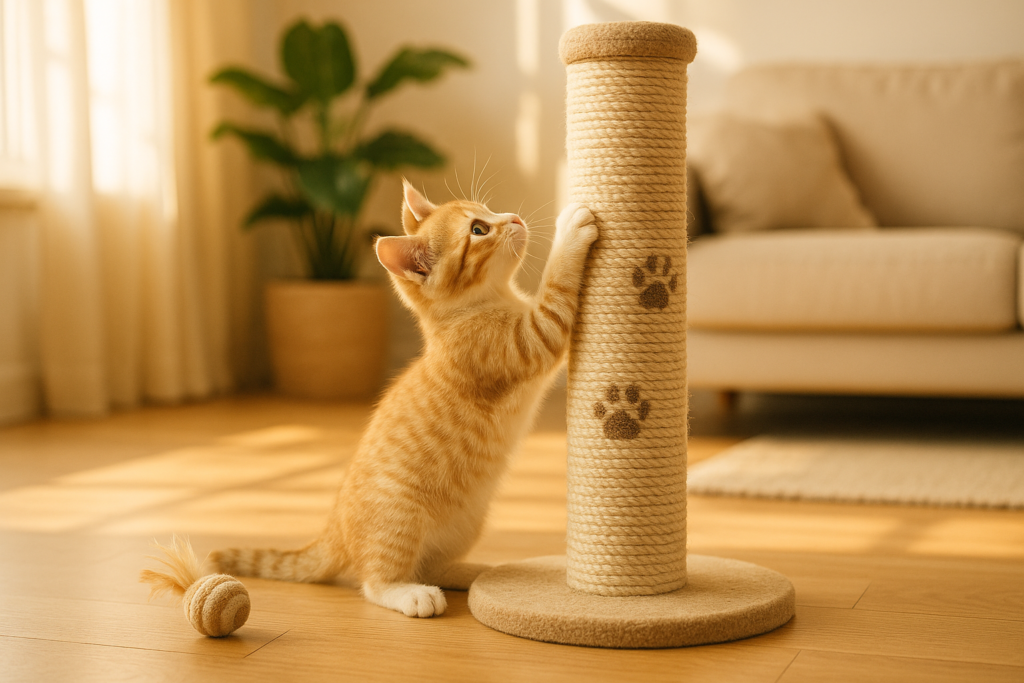
Step 6: Redirect gently, not angrily
If you catch your kitten scratching furniture, stay calm.
Do this instead:
- Interrupt softly with a clap, gentle sound, or your kitten’s name.
- Lead your kitten to the scratching post.
- Use a toy or treat to encourage scratching there.
- Reward as soon as the post is used.
Do not shout. Do not hit. Do not spray water on your kitten. These methods can create fear and do not teach the behavior you actually want.
Your kitten needs guidance, not punishment.
Step 7: Repeat every day
Fast training comes from short, repeated practice.
Try 3 to 5 mini training sessions each day. Each one can be just 1 to 3 minutes long.
That may not sound like much, but kittens learn through repetition. Little sessions work better than one long session.
A Simple Daily Training Plan
Here is an easy plan you can follow.
| Time | What You Do |
|---|---|
| Morning after waking | Bring your kitten to the post and reward any interest |
| After breakfast play | Use a toy to guide scratching on the post |
| After afternoon nap | Place kitten near the post and praise scratching |
| Evening playtime | Encourage post use during active play |
| Before bed | Reward one calm scratching session if possible |
This simple routine can help your kitten learn much faster.
What to Do If Your Kitten Scratches the Couch Instead
This is one of the biggest daily frustrations for kitten owners. If your kitten keeps choosing the couch, do not panic. It just means you need to make a few changes.
Move the post closer
The scratching post should be right next to the couch at first, not across the room.
Try a different texture
If your kitten ignores sisal, try cardboard. If cardboard fails, try another surface. Kittens can have strong texture preferences.
Use more than one scratching option
Some kittens need both a vertical post and a flat scratcher. This gives them a choice.
Clean the couch area
Cats can return to scratched areas partly because of scent marks. Clean the area as safely as you can using pet-safe cleaning products.
Reward faster
You may need to reward your kitten the second they touch the scratching post. Fast rewards help build the habit.
Common Mistakes That Slow Down Training
Sometimes training takes longer because of small mistakes that are easy to fix.
Buying the cheapest post without checking quality
A tiny, shaky post often gets ignored. A better post saves time and stress.
Putting the post in a hidden corner
If your kitten cannot see it during scratching moments, it will not help much.
Waiting too long to redirect
If your kitten scratches the couch for 30 seconds and then you bring them to the post, the lesson is weaker. Try to redirect early.
Punishing your kitten
Fear does not teach the right scratching place. It may only make your kitten anxious.
Not rewarding enough
At first, rewards should happen often. Later, once the habit is strong, you can reward less often.
Giving up too soon
Some kittens learn in a few days. Others need a few weeks. Consistency matters more than speed.
How Long Does It Take to Train a Kitten to Use a Scratching Post?
Many kittens start using a scratching post within a few days if the setup is right. Some need one to three weeks to build a strong habit.
The speed depends on:
- your kitten’s age
- the type of scratching post
- where it is placed
- how often you reward
- whether furniture is still easy to scratch
If you are consistent, most kittens improve much faster than you think.
Best Training Tips for First-Time Kitten Owners
When you are new to kitten care, it is easy to feel stressed. You may be dealing with scratching, biting, climbing, crying at night, and bursts of wild energy all at once.
That is normal.
These simple tips can help:
Keep your kitten on a routine
Kittens do well with regular times for meals, play, rest, and training. A routine helps your kitten feel safe and makes behavior easier to predict.
Use play before training
A kitten with energy often learns better after active play. Let your kitten chase a toy for a few minutes, then guide them to the scratching post.
Trim claws gently when needed
Regular claw trimming can reduce damage while your kitten is learning. If you are unsure how to do it, ask your vet or groomer to show you.
Give enough play and enrichment
A bored kitten may scratch more, bite more, and create bad habits faster. Toys, climbing spaces, and play sessions can help.
Stay patient
Your kitten is a baby animal learning the rules of your home. Progress may not be perfect every day.
Signs Your Kitten Is Learning
Sometimes progress is happening even before the habit is fully fixed.
Look for these signs:
- your kitten sniffs or touches the post more often
- your kitten scratches the post after naps
- your kitten pauses near the couch and then chooses the post
- your kitten responds when you guide them to the post
- furniture scratching happens less often
Even small improvements matter. They show that the lesson is starting to stick.
When You May Need More Than One Scratching Post
Many kitten owners try to solve scratching with one post only. Sometimes that works. Sometimes it does not.
You may need more than one scratching post if:
- your home has multiple rooms
- your kitten scratches in different spots
- your kitten likes both vertical and flat surfaces
- your kitten is very active
- you want to prevent future furniture damage
A good setup might include:
- one tall scratching post near the couch
- one cardboard scratcher near the sleeping area
- one post near a window or play zone
This makes it easy for your kitten to make a good choice no matter where they are.
Should You Use Catnip to Train a Kitten?
Catnip can help some kittens, but not all kittens respond to it, especially very young ones.
If your kitten is old enough and seems interested, you can sprinkle a small amount on the scratching post. This may attract your kitten and encourage rubbing or pawing.
If catnip does not work, try:
- silvervine
- toys
- treats
- gentle praise
- your own fingers tapping the post
Do not worry if your kitten ignores catnip. It is just one tool, not the whole training plan.
How to Stop Night Scratching and Restless Behavior
Many first-time kitten owners lose sleep because kittens get active at night. That can include scratching furniture, crying, pouncing, and running around.
To help with this:
Give a big play session in the evening
Play hard with wand toys, soft balls, or chase games before bedtime. This helps your kitten use up energy.
Feed a small meal after play
A meal after evening play can help your kitten settle down.
Keep scratching posts near active night spots
If your kitten scratches near your bed or bedroom furniture, place a scratching option there too.
Avoid rewarding night crying
If your kitten cries and you rush over every time, the behavior may continue. Make sure needs are met, then respond calmly and consistently.
A kitten that gets enough play, training, and rest during the day is often calmer at night.
FAQ About How to Train a Kitten to Use Scratching Post Quickly
1. How do you get a kitten to use a scratching post fast?
Place the post next to the area your kitten already scratches, then use toys, treats, and praise to make it fun. Reward every time your kitten touches or scratches the post. Fast progress usually comes from good placement and daily repetition.
2. Why is your kitten not using the scratching post?
Your kitten may dislike the size, texture, or location of the post. It may also wobble or feel unsafe. Try a taller, sturdier post and place it close to your kitten’s favorite scratching spot.
3. Should you put your kitten’s paws on the scratching post?
You can gently guide your kitten near the post, but do not force the paws roughly onto it. Many kittens dislike being physically made to scratch. It is usually better to use a toy, treats, or finger tapping to encourage natural scratching.
4. What kind of scratching post is best for a kitten?
A sturdy, tall scratching post with sisal is often a great choice. Some kittens also love cardboard scratchers. If you are not sure, offer both a vertical post and a flat scratcher.
5. Where should you place a scratching post?
Put it where your kitten already likes to scratch, such as near the couch, bed, or favorite play area. Good placement makes training much easier. Hidden corners usually do not work well.
6. How many scratching posts does your kitten need?
One may be enough in a small home, but many kittens do better with two or more. If your kitten scratches in several places, adding more scratching options can help stop furniture damage.
7. Does catnip help train a kitten to use a scratching post?
It can help some kittens, but not all. Very young kittens may not respond to catnip yet. If catnip does not work, use toys, silvervine, praise, and treats instead.
8. How long does scratching post training take?
Some kittens learn in a few days. Others take a couple of weeks. If you stay consistent and reward good behavior often, your kitten will usually improve steadily.
9. Should you punish your kitten for scratching furniture?
No. Punishment can make your kitten fearful or confused. It does not clearly teach where scratching should happen. Redirect your kitten to the scratching post and reward the correct choice instead.
10. Can you train an older kitten to use a scratching post too?
Yes, you can. Older kittens may have stronger habits, so training may take a little longer, but the same method works. Good placement, the right post, and rewards still make a big difference.
Extra Troubleshooting Tips If Training Still Feels Hard
If you have been trying and still feel stuck, take a breath. That does not mean you are failing. It usually means one small part of the setup needs to change.
Try asking yourself these questions:
- Is the scratching post tall enough?
- Does it move when your kitten touches it?
- Is it close enough to the problem area?
- Have you tried another texture?
- Are you rewarding quickly enough?
- Is your kitten getting enough daily play?
- Are there enough scratching options in the home?
Often, fixing just one of these things leads to better results.
A Quick Success Plan You Can Start Today
If you want the simplest possible plan, do this today:
- Put a sturdy scratching post right next to the couch or spot your kitten scratches most.
- Add a second scratcher if you can, especially a cardboard one.
- Play with your kitten near the post.
- Reward every touch, sniff, or scratch on the post.
- Cover the furniture scratching spot with a pet-safe barrier.
- Repeat after naps and playtimes every day.
This small plan can make a huge difference in a short time.
Conclusion
Learning how to train a kitten to use scratching post quickly can feel hard at first, especially when your furniture is already taking damage and you are tired from all the other new kitten challenges. But this problem is very fixable.
Your kitten is not trying to upset you. Your kitten is simply doing what cats naturally do. Once you give your kitten the right scratching post, put it in the right place, and reward the right behavior again and again, things usually start getting much better.
Keep it simple. Stay calm. Be consistent. Use praise, treats, play, and smart setup changes. Most of all, remember that your kitten is still learning.
With a little patience, you can turn couch scratching into scratching post success and help your kitten grow into a happy, well-behaved cat.