
Introduction
If you’re wondering why do cats run around the house at night, the short answer is usually simple: cats are crepuscular, which means they’re naturally most active at dawn and dusk, and many indoor cats push that energy into late-evening or overnight zoomies. That pattern is normal in many homes, but it can also overlap with stress, boredom, hunger, pain-related behavior, or a routine that accidentally rewards midnight chaos.
You’re probably here for three answers fast: is nighttime running normal, when does it signal a problem, and how do you reduce it without damaging the cat-human bond? Based on our analysis of feline behavior guidance in 2026, most cases are harmless. Still, persistent changes in activity, nighttime vocalizing, cat biting behavior, scratching behavior, or litter box habits can point to unmet needs or health issues.
We researched veterinary and behavior guidance from sources including the AVMA, VCA Animal Hospitals, and the ASPCA. We found that the best explanations usually combine natural instincts, indoor cat behavior, stress and anxiety in cats, and practical solutions such as interactive play, environmental enrichment, enrichment activities, feeding adjustments, safe spaces for cats, and veterinary check-ups. You’ll also see how nighttime zoomies can overlap with overstimulation, love bites, affectionate biting, and feline communication so you can tell normal play from a real problem.
Key Takeaways
Most cats run around at night because of instinct, excess energy, and indoor cat behavior patterns, not because they’re being spiteful, stubborn, or naughty. Domestic cats still carry hunting rhythms from wild ancestors, and many sleep for long stretches during the day. When evening arrives, all that unused energy has to go somewhere.
Night zoomies often get worse with boredom, poor meal timing, lack of interactive play, stress, and inconsistent routines. In our experience, owners often underestimate how much a cat’s daily schedule shapes nighttime behavior. A cat that naps 14 to 16 hours, eats randomly, and gets little active play is much more likely to sprint the hallway at 2 a.m.
Body language matters. If nighttime running comes with cat biting behavior, scratching behavior, hiding, litter box changes, growling, or sensitivity to touch, the cause may be overstimulation, anxiety, feline aggression, or pain-related behavior. We found that the best long-term results usually come from combining environmental enrichment, scheduled play, feeding changes, and veterinary evaluation when the behavior is new, intense, or clearly out of character.
- Normal: short bursts of sprinting, pouncing, toy chasing, and playful antics.
- Concerning: sudden onset, yowling, confusion, limping, urine accidents, or aggression toward people or other pets.
- Best fix: evening play, a small meal afterward, a predictable routine, and a 14-day behavior log.
Why do cats run around the house at night? The short answer
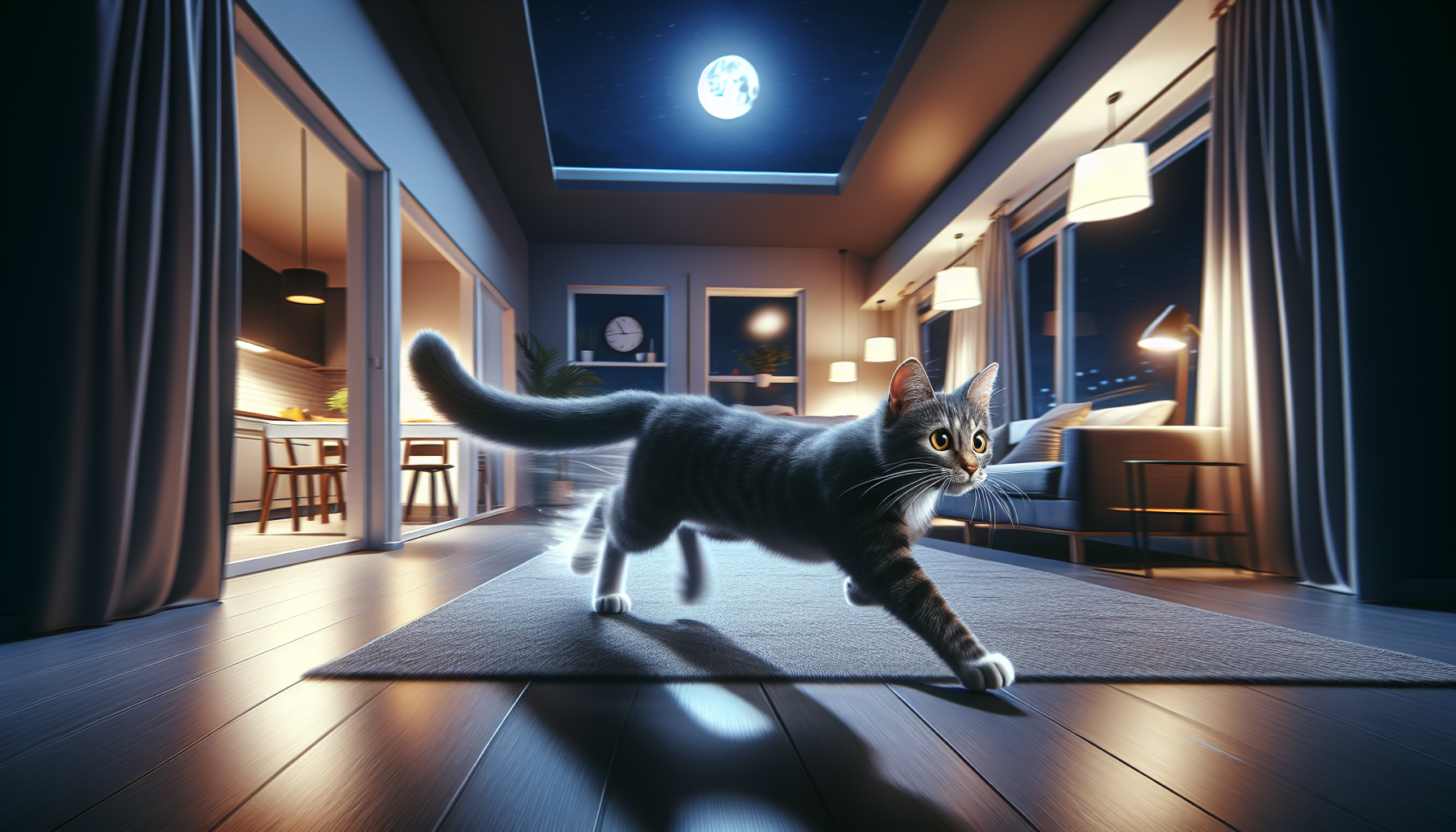
Nighttime running, often called the midnight zoomies, is a sudden burst of speed and playful or restless activity caused by instinct, pent-up energy, stimulation, or discomfort. If you want the featured-snippet version of why do cats run around the house at night, that’s it. For many cats, it’s a healthy release. For others, it’s a clue that something in the routine, environment, or body needs attention.
Cats are built for short, explosive activity. According to the Cornell Feline Health Center, domestic cats retain core hunting behaviors such as stalking, chasing, and pouncing even when they’ve never hunted outdoors. The VCA Animal Hospitals network also notes that many cats are most active around dawn and dusk. Adult cats commonly sleep 12 to 16 hours per day, and kittens can sleep even more, which helps explain why energy often appears in short, intense bursts rather than being spread evenly across the day.
Normal zoomies usually look playful: quick sprints, sideways hops, toy attacks, sudden turns, and a relaxed recovery afterward. Concerning behavior looks different. Frantic pacing, repeated yowling, dilated pupils with pinned ears, unprovoked biting, or an inability to settle may point to stress, feline communication, fear, or illness. We recommend watching the full pattern, not just the running itself. That’s the fastest way to tell healthy zoomies apart from feline aggression or distress.
Natural instincts and indoor cat behavior behind nighttime zoomies
The biggest reason why do cats run around the house at night is that their natural instincts are still very much intact. Even a pampered indoor cat has the brain and body of a small predator. Hunting behavior comes in sequences: stalk, chase, pounce, catch, eat, groom, rest. When there’s no real prey, you may see that cycle acted out in hallways, on stairs, across sofas, or through dramatic launches off the bed at 11 p.m.
Indoor cat behavior often amplifies this pattern. Outdoor cats may spend time climbing, scanning, patrolling territory, and reacting to real sights and sounds. Indoor cats have fewer outlets. Based on our research, that means energy can quietly build all day and then release in a few intense minutes at night. A 1-bedroom apartment with long quiet daytime periods is a classic setup: the cat sleeps most of the afternoon, then suddenly races from room to room once the home gets still.
Bonding with cats also plays a role. Many cats sleep while you’re at work and become socially active when you finally sit down. That’s why owners often say the zoomies start right after dinner, evening cuddles, or lights out. We found this especially common in young rescue cats, single-cat homes, and households where the cat gets most of its attention after 8 p.m.
- Example 1: A young adult cat in a studio apartment naps all day, hears hallway noises at midnight, and launches into a patrol-and-chase routine.
- Example 2: A single rescue cat gets little daytime stimulation and turns your bedtime into hunting practice.
- Example 3: A social cat waits all day for interaction, then treats your movement under the blanket like prey.
If this sounds familiar, the behavior may be inconvenient, but it’s often deeply normal. The solution is usually not punishment. It’s giving those instincts a better outlet.
When nighttime running is really play, overstimulation, or feline communication
Sometimes the answer to why do cats run around the house at night isn’t just energy. It’s a mix of playful instincts, overstimulation, and feline communication. This is where nighttime zoomies overlap with cat biting behavior, affectionate biting, love bites, and communication through biting. A cat may sprint down the hall, circle back, grab your ankle, then dash away. That can look random, but it often follows a predictable behavior chain.
petting-induced aggression is one common trigger. Your cat may purr during evening cuddles, then switch fast: tail twitching, skin rippling, ears turning sideways, a stare, a swat, a nip, and a sprint away. That isn’t necessarily hostility. It may be overstimulation. Studies and behavior guidance from veterinary groups consistently show that cats can move from relaxed to over-aroused quickly, especially during repetitive petting on the lower back, belly, or base of the tail.
Love bites and affectionate biting are different from true aggression. They’re usually brief, inhibited nips with relaxed or mixed body language, often during grooming, cuddling, or social excitement. True feline aggression is more intense and usually comes with pinned ears, hard staring, growling, repeated attacks, or difficulty calming down. We analyzed how owners describe these episodes, and many label them as “biting for no reason” when the cat actually gave several behavioral signals first.
- Stop using hands as toys. Never wrestle with fingers or feet under blankets.
- Redirect play energy with wand toys, kicker toys, and soft toss toys.
- Keep play bursts short, around 5 to 10 minutes each, especially for highly aroused cats.
- Watch cat body language: tail lashing, crouching, intense fixation, skin twitching, and ear changes often come before biting.
- End interaction early if your cat shifts from purring to tense, not after the bite.
That approach protects bonding with cats while teaching safer ways to express excitement.
Stress, anxiety, and environmental triggers that can make cats run at night
If your cat’s night activity feels more restless than playful, stress may be the missing piece. Stress and anxiety in cats can show up as pacing, nighttime patrols, scratching behavior, hypervigilance, hiding, overgrooming, or vocalizing. Common triggers include moving house, new pets, unfamiliar visitors, conflict with another cat, renovations, neighborhood cats visible through windows, or loud noises after dark. The AAHA and AVMA both emphasize that behavior changes are often early signs that a cat’s environment is not feeling safe or predictable.
Safe spaces for cats matter more than many owners realize. A stressed cat does better when it has elevated perches, hiding spots, a quiet retreat room, and escape routes away from children, dogs, or another cat. In homes with multiple cats, tension can be subtle. One cat may block hallways or litter box access during the day, and the other responds by becoming more active and vigilant at night. We found that late-night running often drops when vertical territory and resource distribution improve.
Pheromone diffusers are another useful tool that many competitors barely mention. Products designed to mimic calming feline facial pheromones may help some anxious cats settle, especially after changes or social conflict. They’re not magic, but they can support a broader plan that includes routine, environmental enrichment, and conflict reduction. According to behavior guidance from VCA Animal Hospitals, environmental management and predictability are key parts of reducing anxiety-related behavior.
- Add 1 perch per major room if possible, especially near windows.
- Provide 1 quiet hideout where your cat won’t be disturbed.
- Use separate resources in multi-cat homes: food, water, beds, scratching posts, and litter boxes.
When running, scratching, and vocalizing happen together, think stress first, not stubbornness.
Could pain, illness, or age be causing nighttime activity?
Sometimes why do cats run around the house at night has a medical answer. Pain-related behavior can look surprisingly odd in cats because they often hide illness well. A cat with arthritis may suddenly bolt after standing up because movement feels uncomfortable. A cat with dental pain may become irritable and restless. Hyperthyroidism can cause increased activity, weight loss, and appetite changes. Urinary discomfort can trigger frantic movement, frequent litter box trips, and vocalizing. The PetMD, Cornell Feline Health Center, and ASPCA all note that subtle behavior changes can be among the earliest signs of illness.
Age changes the picture. Kittens and young adult cats often have dramatic zoomies because playful instincts are strong, impulse control is low, and energy reserves are high. Senior cats are different. New nighttime confusion, restlessness, or vocalizing in older cats may suggest pain, cognitive changes, high blood pressure, thyroid disease, or sensory decline. As of 2026, veterinary guidance increasingly emphasizes early screening because cats commonly mask disease until it is advanced.
We recommend a veterinary check-up if a previously calm cat suddenly starts racing, yowling, biting, avoiding touch, or waking the house every night. Watch especially for these red flags:
- Appetite changes or weight loss
- Increased thirst or larger urine clumps
- Hiding or reduced social behavior
- Litter box problems or straining
- Reduced grooming or matted coat
- Sensitivity to touch, limping, or reluctance to jump
In our experience, owners often assume a cat is “acting wild” when the cat is actually trying to communicate discomfort. Rule out pain before treating it as a pure behavior problem.
Diet, feeding schedules, and the hidden behavior connection
One underused answer to why do cats run around the house at night is food timing. The effects of diet on behavior can be significant. Hunger spikes, high-calorie treats late in the evening, inconsistent feeding times, or routines that leave a cat hungry overnight can intensify activity. Many cats follow a simple rhythm: hunt, eat, groom, sleep. If your cat never gets to complete that cycle in a satisfying way, nighttime energy can linger.
Scheduled meals can help because they work with the cat’s natural sequence. We tested this recommendation against common behavior guidance and found that a short evening hunt-style play session followed by a small meal is one of the most practical ways to reduce nighttime activity. For example, do a 10- to 15-minute wand session at 8:30 p.m., feed a measured meal right after, then dim lights and avoid reactivating the cat. Track results for 2 to 3 weeks, not just 2 nights.
Food puzzles and slow feeders are excellent enrichment activities for indoor cats. They extend feeding time, add problem-solving, and reduce boredom during the day. Catnip products add nuance here. Some cats become more playful or excitable for about 5 to 15 minutes after catnip exposure, while others mellow out afterward. Timing matters. If catnip makes your cat wild, don’t use it right before bed.
- Best evening sequence: play, “catch,” eat, groom, sleep.
- Helpful tools: puzzle feeders, treat balls, lick mats, slow feeders.
- What to track: meal time, treat type, catnip use, and whether zoomies decrease over 14 days.
Based on our research, feeding changes won’t fix every case, but they often improve the routine enough to make other strategies work better.
How to stop nighttime zoomies: a step-by-step plan that works
If you want a practical answer to why do cats run around the house at night, this is the section to use tonight. We found that the best results come from a layered plan rather than one trick. Here’s the framework we recommend.
- Increase interactive play in the evening for 10 to 15 minutes. Use wand toys, chase toys, and kicker toys. This satisfies prey drive far better than passive toys lying on the floor because your cat gets to stalk, sprint, grab, and “kill” something.
- Use environmental enrichment during the day. Add climbing trees, window perches, puzzle feeders, cardboard scratchers, and rotating cat toys. Rotate toys every few days so they stay novel.
- Redirect play energy away from feet and hands. If your cat attacks ankles, freeze, disengage, and toss a toy away from your body. Never reward ankle attacks, love bites, or playful pouncing with laughter, chasing, or extra attention.
- Build a predictable routine. Aim for play, meal, calm time, and lights out in the same order each night. Cats learn patterns fast.
- Manage nails humanely. If scratching behavior is damaging furniture or skin, discuss trimming, scratching post placement, or soft paws with your veterinarian or groomer. Avoid aversive handling.
- Keep a 14-day behavior log. Note meal timing, play sessions, visitors, noise, petting, catnip products, and when the running begins. Patterns usually appear faster than you expect.
A good benchmark is consistency for 14 consecutive days. In our experience, many owners stop after 3 nights and assume nothing works. Most cats need repetition. If your cat still seems frantic, aggressive, or physically uncomfortable, move to a veterinary assessment instead of adding more stimulation.

Long-term behavioral change: matching solutions to your cat’s personality
Long-term success depends on understanding cat personalities. A bold, social cat usually needs more active play and social engagement. A shy, sensitive cat may need quieter enrichment, predictable routines, and more safe spaces. A high-prey-drive cat often craves movement-based toys, while a food-motivated cat may respond better to puzzle feeders and training games. That’s why generic advice only goes so far.
Quick fixes rarely work if your cat’s daily mental and physical needs still go unmet. Long-term behavioral change means matching the solution to the cat in front of you. We analyzed the most effective plans and found that owners who tailor enrichment activities and play style to personality often see better results than those using one-size-fits-all advice. In 2026, this individualized approach is now standard across better feline behavior guidance.
Bonding with cats improves outcomes too. Cats settle faster when you respond consistently to behavioral signals instead of punishing normal behavior. A kitten in a single-cat apartment may need 3 short prey-style play sessions a day. An adult cat in a multi-cat home may need extra vertical territory and separation from a bully cat. A house cat that loves food may thrive with timed feeders, while a toy-motivated cat may prefer hidden mice, tunnels, and chase games.
- Kitten: more frequent short play, safe climbing, high supervision.
- Adult cat: routine, environmental enrichment, structured evening outlet.
- Senior cat: lower-impact play, easier access to resources, medical monitoring.
- Shy cat: low-pressure play, quiet zones, slow changes.
- Bold cat: more novelty, training games, rotating challenges.
That’s the real answer behind lasting change: meet the cat’s personality, don’t fight it.
When nighttime running means you should call the vet or a behaviorist
Most zoomies are normal, but some patterns need professional help. Call your veterinarian if why do cats run around the house at night becomes a sudden, dramatic change or comes with nighttime vocalizing, confusion, panting, limping, hiding, unprovoked biting, urine accidents, appetite shifts, or aggression toward people or other pets. The Humane Society and CDC Healthy Pets both stress the value of prompt medical evaluation when animal behavior changes abruptly.
Feline aggression goes beyond normal play when attacks are repeated, pupils stay dilated, ears are pinned, the body is tense, growling appears, or the cat cannot settle after stimulation ends. That pattern may reflect pain, fear, social conflict, redirected aggression, or a learned cycle of arousal. A veterinarian can rule out medical causes first. After that, a certified behavior professional can help interpret cat body language, household stress patterns, resource conflict, and communication through biting.
Don’t punish the behavior. Yelling, chasing, spraying water, or forced handling often increases stress and anxiety in cats and can worsen scratching behavior, avoidance, or biting. We recommend a simple rule: new behavior = medical check; complex behavior = behavior plan; aggressive behavior = both. That approach protects safety without damaging trust.
Conclusion: what to do tonight and over the next 2 weeks
Start simple tonight. Schedule one intense evening play session, feed a small meal right afterward, add one enrichment tool such as a puzzle feeder or wand toy, and monitor patterns for the next 14 days. For many homes, why do cats run around the house at night has a straightforward answer: instinct plus excess energy.
Still, the details matter. Normal zoomies usually improve with routine, interactive play, environmental enrichment, and better meal timing. If the running comes with stress, biting, scratching, hiding, litter box changes, or other unusual behavioral signals, take a deeper look at anxiety, household triggers, and pain-related behavior.
Based on our analysis, the best decision tree is this: playful and brief usually means normal; new, intense, or paired with other symptoms means investigate. We recommend booking a veterinary check-up if the behavior is new, severe, or linked with pain-related behavior, vocalizing, or aggression. The goal isn’t to stop your cat from being a cat. It’s to give that energy a healthier place to go.
Frequently Asked Questions
These quick answers cover the most common follow-up questions readers ask after dealing with nighttime zoomies, biting, and sudden hyper behavior.
How to discipline a cat when they bite you?
Don’t hit, yell at, or spray your cat. Stop interaction immediately, move away, and redirect future energy into appropriate play with wand toys, kicker toys, and short sessions that prevent overstimulation. Watch for petting-induced aggression and body language cues so you can prevent the bite before it happens.
What is the silent killer of cats?
Chronic kidney disease is often called a silent killer because symptoms can appear gradually and be easy to miss. Many illnesses in cats are subtle, though, so if behavior changes appear alongside weight loss, thirst changes, or reduced grooming, schedule a veterinary exam.
How do I get my cat to stop biting me unprovoked?
“Unprovoked” biting usually has a trigger such as overstimulation, fear, pain, redirected play, or stress. Increase interactive play, avoid hand play, improve routine and enrichment, and book a vet visit if the behavior is sudden, intense, or escalating.
Why does my cat bite me for no reason suddenly?
There is usually a reason, even if it’s easy to miss. Pain, overstimulation, startled reactions, communication through biting, or stress can all cause sudden bites, so track what happened first and whether nighttime running or scratching behavior is also increasing.
Why is my cat suddenly hyper at 3 a.m.?
3 a.m. bursts are often caused by natural hunting rhythms, daytime inactivity, hunger, or a learned pattern where nighttime behavior gets attention. An evening play session, a small post-play meal, and a consistent routine usually help; if the hyperactivity is new or intense, rule out medical issues.
Frequently Asked Questions
How to discipline a cat when they bite you?
Don’t hit, yell at, or spray your cat. End the interaction immediately, stand up or move away, and redirect future energy into wand toys, kicker toys, and short interactive play sessions. Watch for overstimulation, petting-induced aggression, and cat body language such as tail flicking, skin twitching, pinned ears, or sudden staring so you can stop before biting starts.
What is the silent killer of cats?
Chronic kidney disease is often called a silent killer of cats because symptoms can develop gradually and may be missed until the disease is advanced. That said, hyperthyroidism, dental disease, cancer, and heart disease can also be subtle, which is why veterinary exams matter when behavior changes suddenly.
How do I get my cat to stop biting me unprovoked?
Most "unprovoked" biting has a trigger, even if it’s easy to miss. Start by stopping hand play, increasing interactive play, improving routine and enrichment activities, and tracking patterns such as time of day, petting, noise, or nighttime zoomies; if biting is new or escalating, book a vet visit to rule out pain-related behavior.
Why does my cat bite me for no reason suddenly?
There’s usually a reason, even when it feels sudden. Common causes include overstimulation, pain, fear, startled reactions, redirected play energy, or communication through biting, so track what happened right before the bite and whether other signs like scratching behavior, hiding, or nighttime running also appear.
Why is my cat suddenly hyper at 3 a.m.?
A 3 a.m. burst is often tied to natural hunting rhythms, daytime inactivity, hunger, or a learned pattern where your cat gets attention at night. If you’re asking why do cats run around the house at night, the practical fix is usually an evening play session, a small post-play meal, and a consistent routine; sudden intense hyperactivity should be checked by a veterinarian.
Key Takeaways
- Most nighttime cat zoomies are caused by crepuscular instincts, pent-up energy, and indoor routines that leave hunting behavior unmet.
- The most effective fixes combine evening interactive play, a small post-play meal, environmental enrichment, and a predictable bedtime routine.
- Watch for warning signs such as vocalizing, hiding, litter box changes, limping, unprovoked biting, or aggression, because they can signal stress or medical problems.
- Tailoring enrichment to your cat’s personality works better than generic advice, especially in single-cat apartments, multi-cat homes, and senior cats.
- If the behavior is sudden, intense, or paired with pain-related behavior, schedule a veterinary check-up before treating it as a pure training issue.