
Are you wondering how to make indoor cats happy in an apartment when your cat seems bored, scratches the couch, cries at night, or acts wild for no clear reason?
Living with an indoor cat in a small space can feel confusing sometimes. You love your cat and want the best for them, but apartment life is very different from the outside world. Your cat cannot chase bugs in a yard, climb trees, or roam around all day. Because of that, you need to help create a home that feels fun, safe, and interesting.
The good news is that you do not need a huge house to raise a happy cat. You just need to understand what your cat needs each day. When you give your cat chances to play, climb, rest, scratch, hunt, and feel safe, apartment life can be calm and joyful for both of you.
In this guide, you will learn practical ways to keep your indoor cat healthy, active, and content in a small home. You will also learn how to handle common problems like biting, nighttime crying, zoomies, litter box trouble, and furniture scratching.
Why apartment cats need extra support
Your cat may live indoors, but their instincts are still very strong. Your cat still wants to stalk, chase, climb, hide, scratch, and watch the world. If those needs are ignored, your cat may become bored, stressed, noisy, or destructive.
That does not mean your cat is bad. It usually means your cat needs better outlets.
A happy indoor cat often has these things every day:
- Play time
- A safe place to hide
- High places to sit
- Things to scratch
- Quiet rest
- Fresh food and water
- A clean litter box
- Attention on their terms
- Mental challenges
When you meet these needs, your cat is much more likely to be calm and well behaved.
Understand what your cat is trying to tell you
Cats do not use words, so they use behavior. If your cat is acting out, they are often trying to say something important.
If your cat scratches furniture
Your cat is not trying to upset you. Scratching helps your cat stretch, mark territory, and keep claws healthy. If the couch is getting scratched, your cat likely needs better scratching choices in the right spots.
If your cat bites or grabs your hands
Many indoor cats bite during play because they are full of energy and do not have enough proper play outlets. Kittens also bite while learning boundaries. Your cat needs toys, not hands, to wrestle and chase.
If your cat cries at night
Night crying can happen because of boredom, hunger, stress, too much daytime sleep, or a need for attention. Sometimes it can also be a health issue, especially in older cats. If the crying is sudden or unusual, a vet check is wise.
If your cat runs around wildly
Those fast zoomies are often normal. Your cat may simply need more active play earlier in the day. A short apartment can still work well if your cat gets chances to run, chase, and climb.
Create a cat-friendly apartment layout
You do not need more square feet. You need to use your space in smart ways.
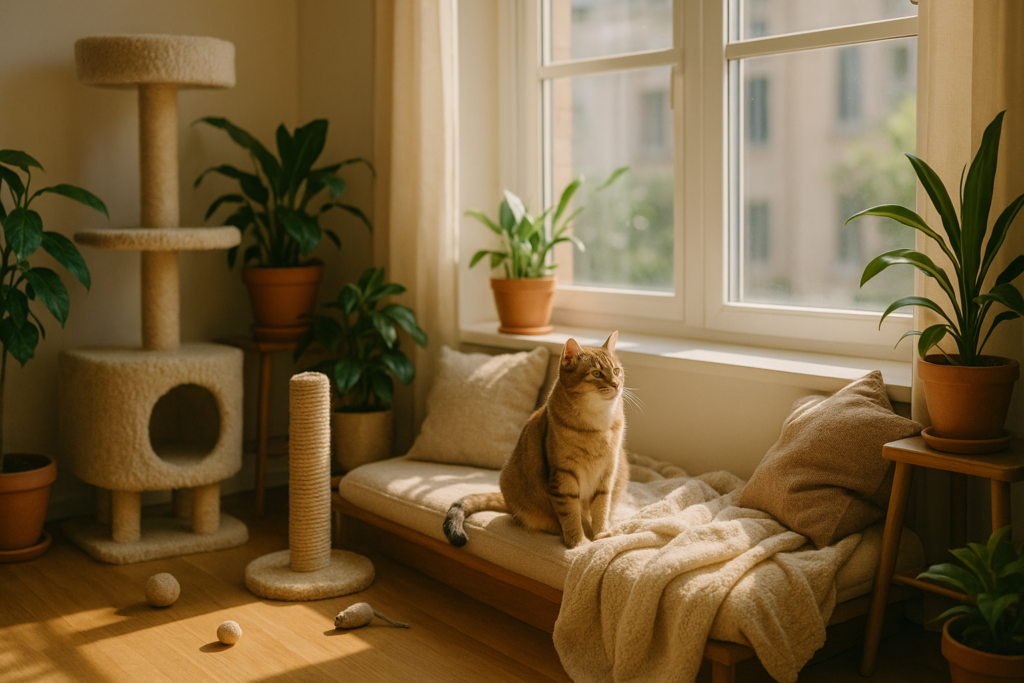
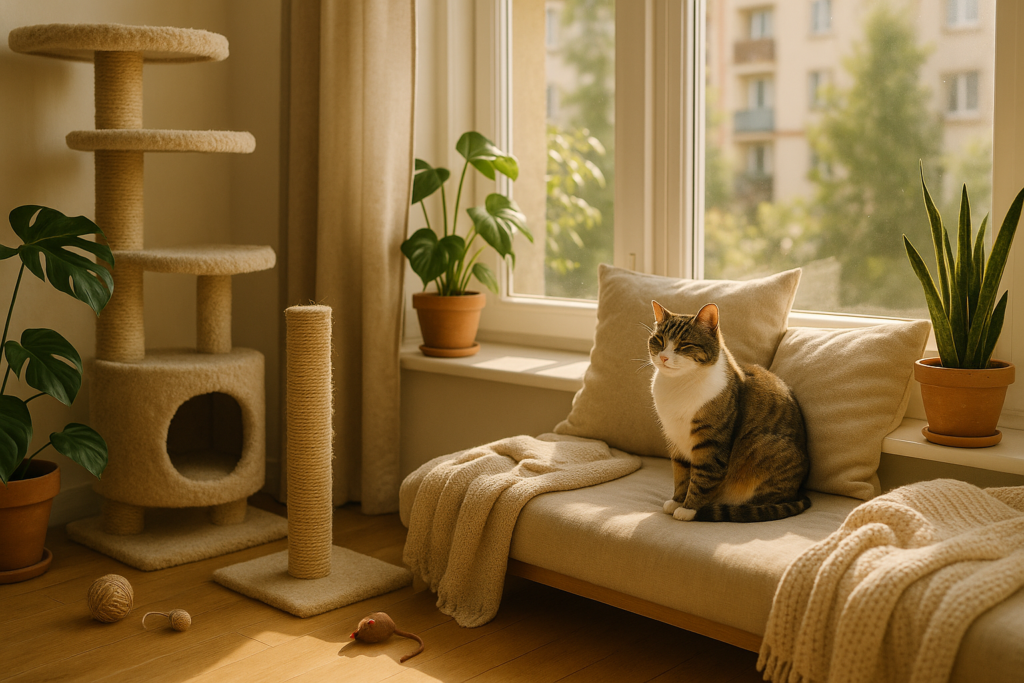
Give your cat vertical space
Cats love height because it helps them feel safe and in control. In an apartment, vertical space matters even more than floor space.
Try adding:
- Cat trees
- Window perches
- Wall shelves made for cats
- A cleared bookshelf level
- A sturdy chair near a window
When your cat can climb and look down on the room, they often feel more relaxed. Height gives your cat exercise and confidence too.
Make room for hiding spots
A happy cat does not only need places to climb. Your cat also needs safe places to hide and rest. This is extra important if you have kids, guests, or loud noises in your building.
Good hiding spots include:
- Covered cat beds
- Boxes with soft blankets
- A quiet space under a bed
- A carrier left open as a safe den
When your cat has a safe retreat, stress often goes down.
Set up window watching stations
A window can be like a television for your cat. Birds, people, leaves, cars, and light changes give your cat mental activity.
If possible, make one or two cozy window spots with:
- A perch
- A bed
- A blanket
- Safe sun exposure
Always make sure screens are secure. Apartment window safety matters a lot for indoor cats.
Give your cat daily play that feels like hunting
One of the best answers to how to make indoor cats happy in an apartment is simple: help your cat act like a hunter.
Cats are built to hunt in short bursts. If your cat never gets to stalk and chase, all that energy can come out as biting, climbing curtains, attacking feet, or waking you up at 4 a.m.
Use interactive toys
The best play usually happens when you join in. Wand toys are one of the top choices because they let your cat chase, pounce, jump, and catch.
Good options include:
- Feather wands
- Ribbon toys
- Mice on strings
- Small balls for tossing
- Toy bugs that move
Move the toy like prey. Let it hide, dart, and stop. Your cat will enjoy the game much more than if you just wave it around.
Let your cat catch the toy
Play should not end with endless frustration. Every session should let your cat catch the toy at times. This helps your cat feel satisfied.
A simple play pattern is:
- Stalk
- Chase
- Pounce
- Catch
- Small treat or meal
This works with your cat’s natural rhythm.
Keep sessions short but regular
Most cats do best with short play sessions one to three times a day. Even 10 to 15 minutes can help a lot.
Try these times:
- Morning before breakfast
- Late afternoon
- Evening before bed
An evening play session is especially helpful if your cat gets wild at night.
Prevent boredom with enrichment activities
Play is important, but your cat also needs mental stimulation when you are busy.
Rotate toys
If every toy stays out all the time, your cat may lose interest. Put some away and switch them every few days.
This makes old toys feel new again.
Use puzzle feeders
Puzzle feeders make your cat work a little for food. This slows eating and gives your cat something to think about.
You can use:
- Store-bought puzzle feeders
- Treat balls
- Food hidden in small cups
- A muffin tin with toys covering the food
These are great for cats that eat too fast or seem bored between meals.
Offer safe things to sniff and investigate
Cats enjoy new scents and textures. You can sometimes add fun by giving your cat safe items like:
- Paper bags with handles removed
- Cardboard boxes
- A blanket moved to a new spot
- Catnip or silvervine, if your cat enjoys it
Tiny changes can make apartment life feel richer.
Help your cat scratch in the right places
Scratching is normal and healthy. Your job is not to stop scratching. Your job is to guide it.
Provide more than one scratching surface
Different cats like different types of scratchers. Some prefer upright posts. Some like flat cardboard scratch pads. Some like angled scratchers.
Try offering:
- A tall sisal post
- A cardboard scratch pad
- A lounge scratcher
- A carpet-free scratching option
The post should be sturdy and tall enough for a full body stretch.
Put scratchers where your cat already wants to scratch
Location matters. If your cat scratches the sofa arm, put a scratching post right beside it. If your cat scratches after naps, place a scratcher near the sleeping area.
This makes it easy for your cat to choose the right item.
Reward the behavior you want
When your cat uses the scratching post, offer praise, petting, or a small treat if your cat likes that. Positive feedback helps your cat repeat the behavior.
You can also make the post more appealing with catnip or by playing near it.
Build a calming daily routine
Cats usually feel safest when life is predictable. In an apartment, routine can lower stress and reduce behavior problems.
Try to keep these things fairly consistent:
- Feeding times
- Play times
- Litter box cleaning
- Quiet sleep areas
- Your response to behavior
If one day your cat gets attention for midnight crying and the next day gets ignored, your cat may become more confused. A calm routine helps your cat know what to expect.
Make feeding time more satisfying
Food is not only about nutrition. It can also be enrichment.
Feed measured meals if possible
Some cats do fine with free feeding, but many indoor cats do better with planned meals. Meals create structure and can help with weight control.
You can ask your vet how much food your cat needs based on age, weight, and activity.
Split food into smaller meals
Cats often like several small meals instead of one or two huge ones. Smaller meals can better match their natural eating pattern.
If your schedule is busy, an automatic feeder can help.
Add a little hunting to meals
Instead of always putting food in one bowl, sometimes try:
- Treat hunts
- Puzzle feeders
- Small portions in different spots
- Dry food in a rolling toy
This can make apartment living more exciting and help your cat use their brain.
Keep the litter box clean and easy to use
A dirty or stressful litter box setup can make both you and your cat miserable fast.
Follow the basic rule
A good rule is:
One litter box per cat, plus one extra
In a small apartment, that may sound hard, but even two well-placed boxes can make a big difference for one cat that is picky.
Choose a quiet location
Do not put the litter box right next to loud machines, heavy foot traffic, or food and water bowls. Your cat wants privacy and peace.
Scoop often
Many cats want a very clean litter box. Scoop at least once a day, and more if needed. Wash the box regularly and refill with litter your cat likes.
If your cat suddenly stops using the litter box, do not assume it is bad behavior. It may be a sign of pain, stress, or a medical problem.
Give your cat a safe and restful sleep space
Cats sleep a lot, but they still need the right places to do it.
Your cat may like different sleeping spots for different reasons:
- Warm sunny spots
- High perches
- Soft beds
- Quiet corners
- Hidden enclosed spaces
Try giving your cat choices. Some cats like being near you. Others want more privacy.
A well-rested cat is often a calmer cat.
Reduce stress from noise, people, and change
Apartment life can include sounds your cat cannot control. Neighbors, doors slamming, hallway noise, elevators, dogs barking, and guests can all create stress.
Protect your cat from overstimulation
If your cat seems nervous, help by giving them:
- A quiet room during busy times
- A covered bed or box
- Soft background sound
- A routine they can trust
Do not force your cat to greet guests. Let your cat choose.
Introduce changes slowly
New furniture, a new pet, moving boxes, or even a different cleaning smell can upset some cats. Make changes little by little when you can.
Keep familiar items nearby, such as favorite beds, blankets, and scratchers.
Handle kitten biting and rough play gently
Many people lose sleep because of kitten biting, pouncing on feet, and nonstop chaos. This is common, but you can guide it.
Never use your hands as toys
If you wrestle with your kitten using your fingers, your kitten learns that human skin is for attacking. That habit can become painful later.
Always use toys for active play.
End play if biting starts
If your kitten bites during petting or play, stop the action calmly. Move away for a short moment. Then restart with a toy.
This teaches your kitten that biting makes fun stop, while toy play keeps fun going.
Give your kitten enough play every day
Kittens have huge energy. If your kitten is biting all the time, they may need more active sessions, more climbing options, and more mental enrichment.
Keep your cat active without needing a lot of room
A small apartment can still support a healthy cat if you think in layers and routines.
Here are smart ways to add movement:
| Apartment need | Easy solution | Why it helps |
|---|---|---|
| More climbing | Cat tree or shelves | Builds confidence and exercise |
| More running | Hallway toy toss or wand play | Burns energy |
| More jumping | Perches and safe furniture paths | Keeps muscles active |
| More hunting | Puzzle feeders and chase games | Fights boredom |
| More curiosity | Window spots and toy rotation | Adds mental stimulation |
You do not need to do everything at once. Even one or two changes can improve your cat’s mood.
Watch your cat’s body and health
Sometimes what looks like a behavior problem is really discomfort.
Signs your cat may need a vet check
Pay attention if your cat suddenly shows:
- Night crying
- Litter box accidents
- Aggression
- Hiding more than usual
- Eating less
- Drinking much more
- Weight loss or gain
- Excess grooming
- Low energy
Pain, urinary problems, stomach trouble, dental pain, and other health issues can change your cat’s behavior fast.
If something seems off, trust your gut.
Consider getting a second cat carefully
Some indoor cats enjoy a cat friend, but not all do. A second cat is not an automatic fix for boredom.
A new cat can help if your current cat is social, playful, and lonely when alone. But it can also increase stress if personalities do not match.
Before adopting another cat, think about:
- Your space
- Your budget
- Your current cat’s temperament
- Your ability to do a slow introduction
In a small apartment, a bad cat match can be very stressful. Choose carefully.
Simple daily routine for a happy apartment cat
If you feel overwhelmed, keep it simple. A basic routine can already help a lot.
Morning
Feed your cat a measured meal. Spend 10 minutes playing with a wand toy. Scoop the litter box and refresh water.
Midday
Leave out a puzzle feeder or a few rotated toys. Make sure your cat has access to a window perch or resting space.
Evening
Do another active play session. Let your cat stalk, chase, and catch. Offer dinner after play. Give calm attention if your cat wants cuddles.
Before bed
Do a quick litter scoop. Put away unsafe toys. Give your cat one last calm play session if nighttime zoomies are a problem.
Common mistakes that can make indoor cats unhappy
Sometimes loving cat owners do things that accidentally create stress. That is normal. You can always make changes.
Too little play
Many behavior problems come from not enough interactive play. Toys left on the floor are not always enough.
Too few scratching areas
One tiny scratching post hidden in a corner usually will not solve furniture scratching.
No vertical territory
If your cat has nowhere to climb, your apartment may feel smaller and less secure to them.
Inconsistent rules
If you let your cat bite your hands sometimes but not others, your cat gets mixed messages.
Ignoring stress signs
A cat that hides, overgrooms, or acts grumpy may be stressed or uncomfortable, not stubborn.
How to make your apartment feel bigger to your cat
This idea helps many owners. Your cat does not measure happiness by square feet the way humans do. Your cat cares more about whether the space meets their needs.
You can make your home feel bigger by adding:
- Height
- Hiding spaces
- Window views
- Pathways across furniture
- Rotating enrichment
- Daily hunting games
A small apartment with good cat enrichment can feel much better than a large empty room.
FAQ: How to make indoor cats happy in an apartment
1. Can a cat be truly happy in an apartment?
Yes, your cat can be very happy in an apartment if you provide play, climbing space, scratching areas, routine, and mental stimulation. Size matters less than how well the space meets your cat’s needs.
2. How much play does an indoor cat need each day?
Most indoor cats benefit from at least 20 to 30 minutes of interactive play daily, split into short sessions. Kittens and very active cats may need more.
3. Why does your indoor cat cry at night?
Your cat may cry at night because of boredom, hunger, stress, too much daytime sleep, or a health issue. Try more evening play and a steady bedtime routine. If the crying is sudden, ask a vet for advice.
4. How do you stop your cat from scratching the couch?
Give your cat better scratching options near the couch, such as a sturdy post or cardboard scratcher. Reward your cat for using them and make the couch less tempting while your cat learns.
5. Do indoor cats get bored easily?
Yes, many indoor cats can get bored if they do not have enough stimulation. Bored cats may bite, meow, knock things down, overeat, or zoom around at night.
6. Are window perches good for apartment cats?
Yes, window perches are great for many apartment cats. They offer sun, rest, entertainment, and a safe way to watch the outside world.
7. Should you leave toys out all the time?
It is better to rotate toys. If your cat sees the same toys every day, they may lose interest. Rotating keeps playtime fresh and exciting.
8. Is one litter box enough for one indoor cat?
Sometimes, but many cats do better with two boxes, even in an apartment. A clean, quiet litter setup can prevent stress and accidents.
9. Will another cat make your indoor cat happier?
Maybe, but not always. Some cats love companionship, while others prefer being the only pet. You should think about personality, space, and careful introductions first.
10. What is the best way to calm a hyper indoor kitten?
Use daily interactive play, provide climbing areas, avoid using hands as toys, and keep a simple routine. A tired kitten is usually a calmer kitten.
Final thoughts
If you want to know how to make indoor cats happy in an apartment, the heart of it is this: help your cat live like a cat, even indoors.
Your cat needs more than food and a place to sleep. Your cat needs chances to hunt, climb, scratch, hide, rest, and feel safe. When you build those things into your apartment and keep a steady routine, many common problems start to improve.
Do not worry if you have not done everything perfectly. Most cat owners learn by watching their cat and making small changes over time. Start with the basics. Add a scratching post in the right place. Do one extra play session before bed. Create a window perch. Try a puzzle feeder. Little steps can make a big difference.
You know your cat better each day. With patience, simple routines, and a bit of creativity, you can turn your apartment into a place where your cat feels relaxed, active, and truly at home.